
Physiology:
Calcium and carbon based skeletal structure is covered by muscular stretchy fibers. Three major layers of flesh cover both skeletal and muscular structure.
General Appearance
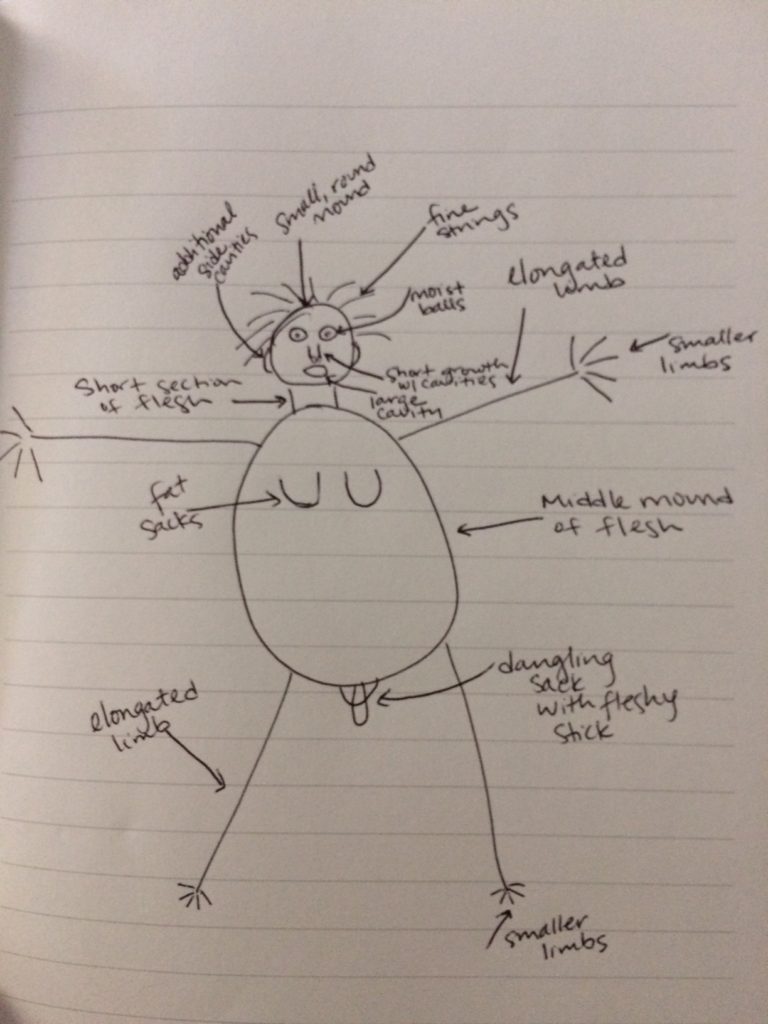
This species has one main mound of flesh in the middle of their form and four elongated limbs- two growing out from the mound at the sides near the top and two growing from the bottom of the mound. At the end of each elongated limb there are even smaller limbs- five individual at the end of each for a total of twenty. At the top of the larger mound there is a short section of flesh that connects to a small, round mound. This round mound has a number of important characteristics that the species appear to use to identify each other, interpret reality, and communicate with their surroundings. One characteristic is the growth of thousands of fine strings from the top of the small round mound. Another characteristic is two round moist balls set into recessed sockets near the top of the mound. The balls are mostly white except for the very middle where there is a colored circle around a black dot. Yet another characteristic is a short growth in the middle of the small mound that is divided into two cavities connecting to the inside of the mound. There are two more additional cavities on the sides of the mound. And finally there is one large cavity that can open and close placed right below the short growth. Frequent movements on the round mound include an opening and closing of the large cavity, a thin layer of flesh covering and uncovering the moist balls, and the constant inhalation of oxygen/exhalation of carbon dioxide through the two cavities that make up the short growth. In addition, some of these species have two fat sacks that grow near the top of the middle mound of flesh, and some have a dangling sack and fleshy stick near the bottom of the middle mound.
Other Observations:
The fine strings that grow from the top of the round mound also appear to grow in a thinner, shorter variety along the elongated limbs and on the middle mound of flesh. Flesh tones vary in color and include darker and lighter tones of black, brown, and beige. The fine strings also vary in color and natural growth may include tones of black, brown, red, and yellow. Moist balls vary in color tone as well and include a wider variety of browns, greens, and blues.
Note: In accordance with code OBEWH2016 the final report will be submitted on January 1, 2018 to the higher council of extra-planetary research. Objective observations are sent every 7 full rotations of the planet in respect to its star and followed by a short summary of findings as directed in the standardized outline for observational reports presented in Handbook 32.7767.96.7970.